
Chennai · Tamil Nadu
Business Automation in Chennai
Take the manual steps out of the back office
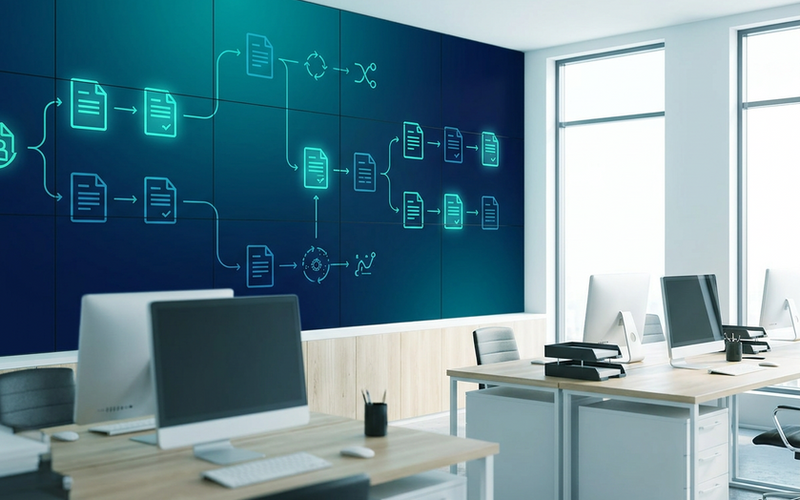
Business Automation for Chennai businesses
Chennai runs on automotive manufacturing, it services and healthcare, with most commercial technology work concentrated around OMR IT Corridor and Guindy. Businesses here tend to reach us when a system that coped at a smaller scale stops coping — an order flow, an approvals queue or a reporting process that has outgrown the way it was built.
Back-office work quietly accumulates manual steps: a spreadsheet that gets emailed for approval, an invoice re-typed from a PDF, a status that only updates when somebody remembers. Each one is small. Together they are a full-time role nobody budgeted for.
We map the process as it actually runs — including the workarounds people invented — then automate the steps that are genuinely mechanical and put clear handoffs around the ones that still need a human. The measure of success is simple: fewer places where work waits for someone to notice it.
Where this applies in Chennai
Chennai’s commercial base is concentrated in automotive manufacturing, it services, healthcare, ports and logistics. Those sectors carry different constraints, and the shape of the work follows them rather than a fixed template.
We work with clients across OMR IT Corridor, Guindy, T Nagar, Ambattur and the wider Chennai area.
What’s included
- Process mapping and automation opportunity assessment
- Workflow orchestration and approval routing
- Robotic process automation for systems without APIs
- ERP and CRM automation and data synchronisation
- Invoice, order and document processing pipelines
- Operational dashboards and exception alerting
What you get out of it
- Approvals that move in hours rather than sitting in an inbox for days
- Fewer errors from manual re-keying between systems
- Staff time returned to work that actually needs judgement
Business Automation in Chennai
Business Automation in Chennai: common questions
Do you work with businesses in Chennai?
Yes. We deliver software, AI, web and SEO projects for Chennai businesses, working remotely as standard with on-site visits where a project genuinely needs them. Our registered offices are in Bangalore and Beawar, Rajasthan.
Which Chennai industries do you build for most?
Chennai's commercial base concentrates in automotive manufacturing, it services, healthcare and ports and logistics, and each carries different constraints. We start from the operational bottleneck rather than the platform — an order flow, an approvals queue, a catalogue buyers cannot search — and pick the technology after that.
We already have a website. Can you work with it?
Usually, yes. We audit what is there before proposing a rebuild — sometimes the structure is sound and the problem is speed, indexing or content. Redesigns and rescues of half-finished builds are a large share of what we take on.
Which parts of Chennai do you cover?
All of it. Most of our Chennai enquiries come from businesses around OMR IT Corridor, Guindy, T Nagar, Ambattur, but delivery is remote-first, so where you sit in the city makes no difference to how we work or what we charge.
How much does a website or software project cost in Chennai?
Cost follows scope, not location — we do not price differently by city. A brochure site is a different job from an ecommerce build or a custom application. We scope the work before quoting, and say so plainly when the answer is smaller than you expected.
What kinds of processes are worth automating?
The mechanical ones: approvals routed by email, invoices re-typed from PDFs, data copied between systems, statuses that only update when somebody remembers. The test is whether the step requires judgement. If it does, we automate around it and leave a clean handoff rather than replacing the person.
Can you automate a system that has no API?
Yes, through robotic process automation that drives the interface the way a person would. It is less robust than an API integration and breaks when the vendor changes their screens, so we treat it as a pragmatic bridge rather than a permanent architecture, and we say so up front.
Will automation mean job losses?
In our experience it usually means the same team stops doing work they resented and handles more volume without new hires. We map the process as it actually runs, including the workarounds people invented, and automate the mechanical steps. Where a role changes substantially, that is a conversation to have openly at design time rather than a surprise at delivery.
Selected work
Projects running in production
Eklavya Agrochemicals
HighVeg, HighFlower, Emerger, Kelper, SuperCane Kit, Sucrolin, Promter, Hepta, HighSpeed.
The Purple Fig Cooking School
The Purple Fig Cooki
Rad Routine
Healthy food on the go! We have a range of Granola and Granola Bars. We ship Pan India.